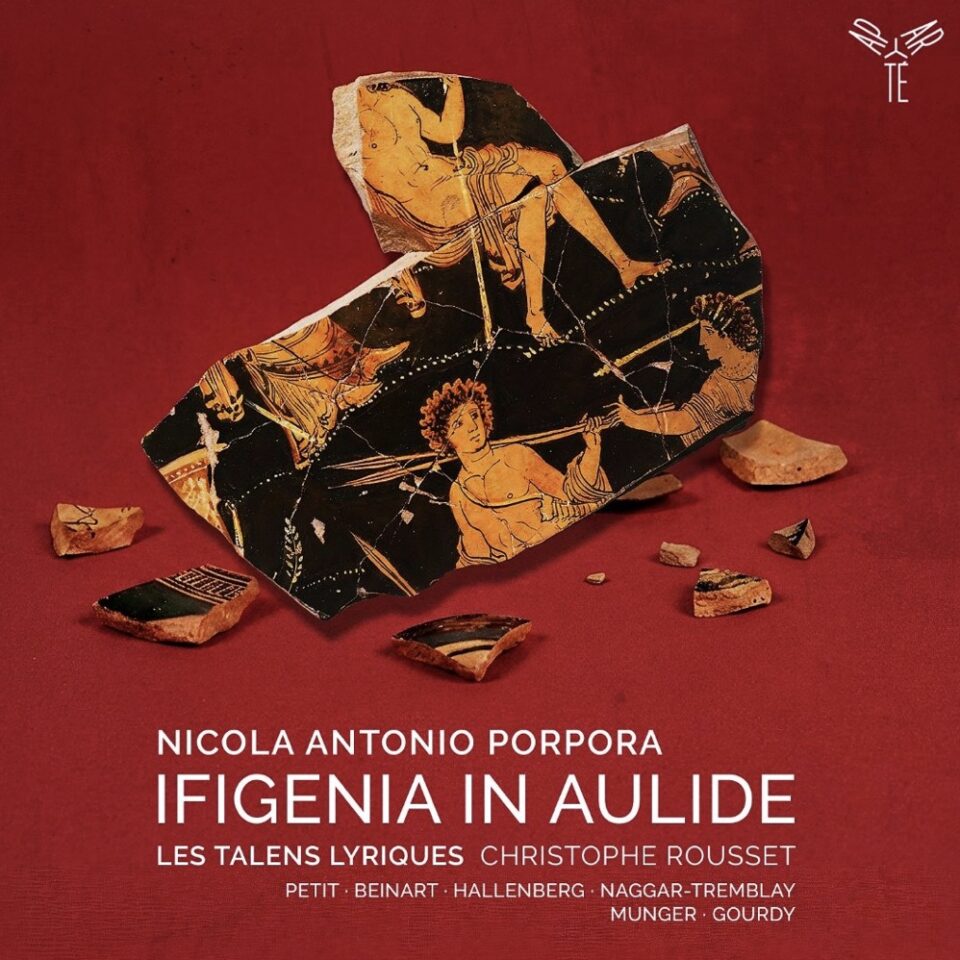
By the time Nicola Porpora arrived in London in 1733, he had already made his name in Italy as an opera composer and as the singing teacher of Farinelli, the most celebrated castrato of his generation. A group of aristocrats backed by Frederick, Prince of Wales, recruited the Neapolitan composer to lead their new Opera of the Nobility, founded to compete with Handel’s company. Porpora opened its first season with Arianna in Naxo, nearly a month before Handel unveiled his own opera on the same myth, Arianna in Creta. Within two years, Porpora was writing the role of Achilles in Ifigenia in Aulide for his former pupil.
Iphigenia comes to Aulis expecting to marry Achilles. Instead, her father, Agamemnon, has summoned her to be sacrificed so that Diana will restore the winds and let the Greek fleet sail for Troy. That cruel deception sets the opera in motion, turning the prelude to the Trojan War into a family tragedy. Ifigenia in Aulide premiered at London’s King’s Theatre in May 1735 with two of the most celebrated castratos of the day: Farinelli as Achilles and Senesino, formerly Handel’s leading man, as Agamemnon. Nearly three centuries later, Christophe Rousset and Les Talens Lyriques give the opera its first commercial recording.
Rousset led the opera’s modern premiere at the Bayreuth Baroque Opera Festival in 2024, but he assembled an entirely new cast for the recording: Mélissa Petit, Noa Beinart, Ann Hallenberg, Rose Naggar-Tremblay, Marie-Ève Munger, and Olivier Gourdy. It was recorded in a studio just outside Paris, a controlled environment free of stage noise.
I’m not a huge fan of this operatic style of vibrato. That said, the singers are all on the same page, which I find an asset to the production’s artistic vision. What’s worse, in my view, is vibrato or a singing style applied inconsistently across a cast. Here the same style is applied, and applied with technical command, by everyone. There’s often a disconnect in using a female voice for a male role, but it’s done often enough that few will likely care.
The orchestra’s energetic Sinfonia is tight and athletic, and that energy carries straight into the opening aria (track 3), which Munger, as Ulisse, takes with special extravagance. Her repeated reaches for the top of her range are arresting.
Beinart is next, as Agamennone (track 5). A contralto, she doesn’t have Munger’s ability to cut through the orchestral texture, but she too keeps pace with Les Talens Lyriques.
Petit’s entrance as Ifigenia brings a more feminine timbre that contrasts well with the voices heard so far. She also has good command, though her faster vibrato may not be to everyone’s taste.
The only singer here I’ve heard live is Ann Hallenberg, who sings Achille, Ifigenia’s intended husband and her fiercest defender. When Achille learns that she has been brought to Aulis to die, he challenges the high priest Calcante, who insists the gods demand her sacrifice; their argument becomes a duet at the end of Act II. At the altar, Achille is ready to intervene by force when Diana appears and spares Ifigenia. Hallenberg applies ample vibrato, in line with the rest of the cast.
Naggar-Tremblay enters as Clitennestra in track 11 and shows great control and synchronization with the ensemble.
Calcante’s first aria (track 15) is set against rather dramatic music. Gourdy has good projection, and this aria in particular demands sustained dexterity, which he delivers.
Opera as a genre doesn’t excite me much. You won’t often find me taking in a complete one, but I do enjoy a good aria (as did audiences of the day). Given his talents as a composer, Porpora is decidedly underrepresented in today’s recorded canon; his fame rests on his work as a teacher of singers. While auditioning this opera, set to a libretto by Paolo Antonio Rolli, I kept comparing its music and dramatic effects with those of George Frideric Handel.
Conclusion
I received a pre-release copy of this album, but only the first disc was accessible, so I don’t think it’s fair to assign a rating. I was nonetheless very impressed with Les Talens Lyriques, a well-oiled band with real dynamic strength. As stated, the vocalists were all strong as well.
I look forward to returning to this on its official release to explore the opera’s second half. Making the first recording of an opera is a risky business, and I applaud Rousset and company for putting this out for us to enjoy. The value is high, given the quality of the writing and of the musicians assembled.