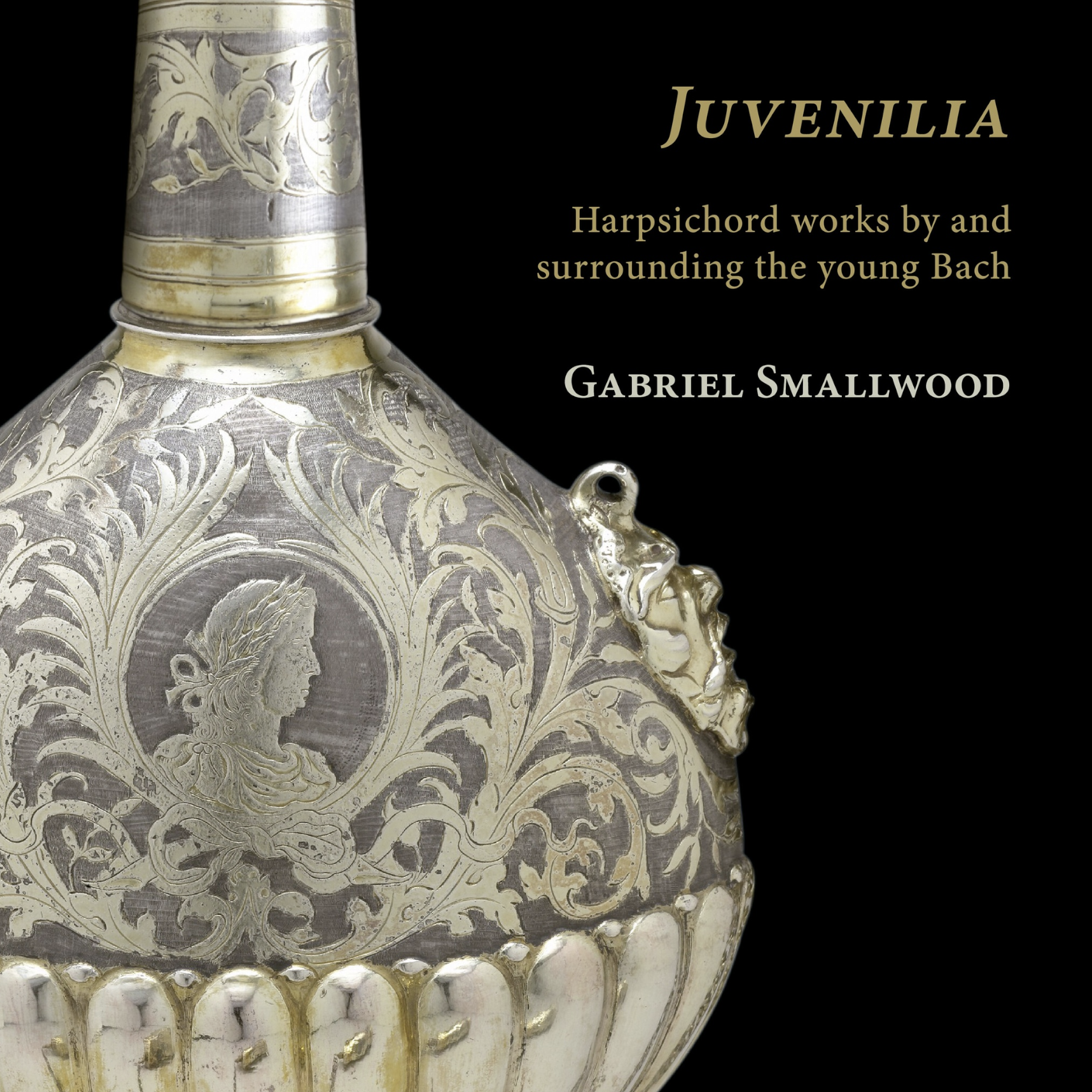
Juvenilia • Gabriel Smallwood
The concept behind this album, featuring early works for keyboard by Johann Sebastian Bach, is to perform his early works within the context of the music he might have known during his youth. The pieces themselves are not particularly obscure ones, given that Bach’s keyboard oeuvre has been well covered on both piano and upon historical instruments. Listeners may be less familiar with the works by other composers, including Böhm, Ritter, Reincken, and Buxtehude.
The liner notes include some historical background upon the pieces, alongside a message from Smallwood, who explains his intent in recording works by Bach alongside those by his contemporaries.
The recording was made at the Evangelische Kirche St. Leodegar, in Grenzach-Wyhlen, Germany. The recording engineer and producer, Rainer Arndt, should be credited here for producing an ink black recording (during silences), perfectly presenting Smallwood’s instrument, an Andrea Restelli made copy of a 1738 original from Hannover. The full compass of the instrument comes across beautifully in this recording.
For those unfamiliar with the artist, he grew up in South Carolina before moving to Europe in 2016; he’s currently based in Basel and this is his debut solo recording.
Stylistically, there’s something connecting both the Prelude and Fugue, BWV 896 to the Capriccio BWV 992, both recorded here. It’s difficult to imagine these pieces came from a different composer; the repeated figure in the fugue is reminiscent of the posthorn theme from the longer suite, the one supposedly written in celebration of the leaving of Bach’s brother from the familiar home. In both cases, Smallwood’s performances highlight good tempo choices and very clean, articulate playing.
A four-movement suite by Christian Ritter precedes the Toccata BWV 910 in the same key. The piece is known to us via the sources used for the pieces not by Bach, the Möller Manuscript and the Andreas Bach Buch. The opening Allemand by Ritter made a connection for me to the earlier recording released at the end of last year by Jean Rondeau of Louis Couperin’s music. The association is connected both by the rich resonance of the instruments used, but also in the way that both composers use harmony as an affective device. The stylistic approach to each piece is different, with Rondeau’s performance of Couperin using more rubato, as feels appropriate.
The Courant from the same suite is brilliant, decorated quite baroquely with ornaments. The Saraband features a delicious harmonic progression; and the Gigue is quirky, giving good exercise to both hands with a tight, imitative rhythmic motive. I think Smallwood makes the case for the young Bach having access to great resources through the music collection assembled by his brother and guardian.
There is a considerable contrast in style from the Ritter suite and opening of Bach’s toccata. Smallwood takes advantage of the tuning of his instrument to highlight the exotic key of F-sharp minor through Bach’s own harmonic journey, offering piquant resolutions before landing upon sweetly tuned triads. There’s a very practical reason one might want to write in such a key, my opinion inserting here—and that’s something a performer must address through a choice of tuning for the harpsichord. I found Smallwood’s performance here, especially so in the faster contrapuntal section, brilliant. His performance includes changes in registration upon his instrument, the doubling at the octaves at the start as grand a sound he might produce without going to one of the exotic instruments with a 16’ course of strings. The work too provides the greatest contrast in Bach’s own style, being the most mature of the works presented on this program. We’ve come a long way since my favorite Fantasia BWV 917—even if only a few years separates their composition.
We go back even further in time when listening to the Suite in D, BWV 963. The five movement work opens simply in comparison to the grandiose opening of the Toccata. The imitation in the opening movement, again, mimics the style in the Bach Capriccio. The second movement for me represents Bach “feeling,” wherein the fugue that follows showcases his learned style, presenting a good theme in formal counterpoint. The ending is brilliant, something that shows something of a real human touch, tapping into humor but also young brilliance. It’s the kind of piece that had to have been written to delight the listener. This piece as a whole is a testament to what the young Bach, at the age of eighteen, had been doing for much of his entire life up to that point: soaking up various musical styles and ideas, alongside developing his technique at various keyboards.
The Reincken Toccata in G becomes a great model for Bach: it opens in a traditional way, to warmup the fingers and help establish the quality of the instrument’s tuning before the imitative section gives independence to the voices realized between two hands. As I have often wondered what models Bach used for his toccatas, this piece provides a good context. At first I found this an odd piece to end with, as I tend to think of toccatas as opening pieces; but it works I think against the brilliant piece by Buxtehude that opens the album in G minor.
The musical material here makes for a good album or concert concept; but what sets this performance apart for me is the strong interpretive voice behind the hands. I get the sense that Smallwood lived with each of these pieces for some time. His technical brilliance comes to light multiple times, while also showing us the brilliance of allowing us to marinate in the sound of the instrument with the harmonic richness left to us by these composers.
As for a way to introduce yourself, I think Gabriel Smallwood has done very well. He’s done well to choose pieces that stylistically weave into the pieces by Bach. And as an interpreter, I really found no faults in his choices, finding his own voice supporting this music very well.