Biber: Vesperæ a 32 • Ars Antiqua Austria
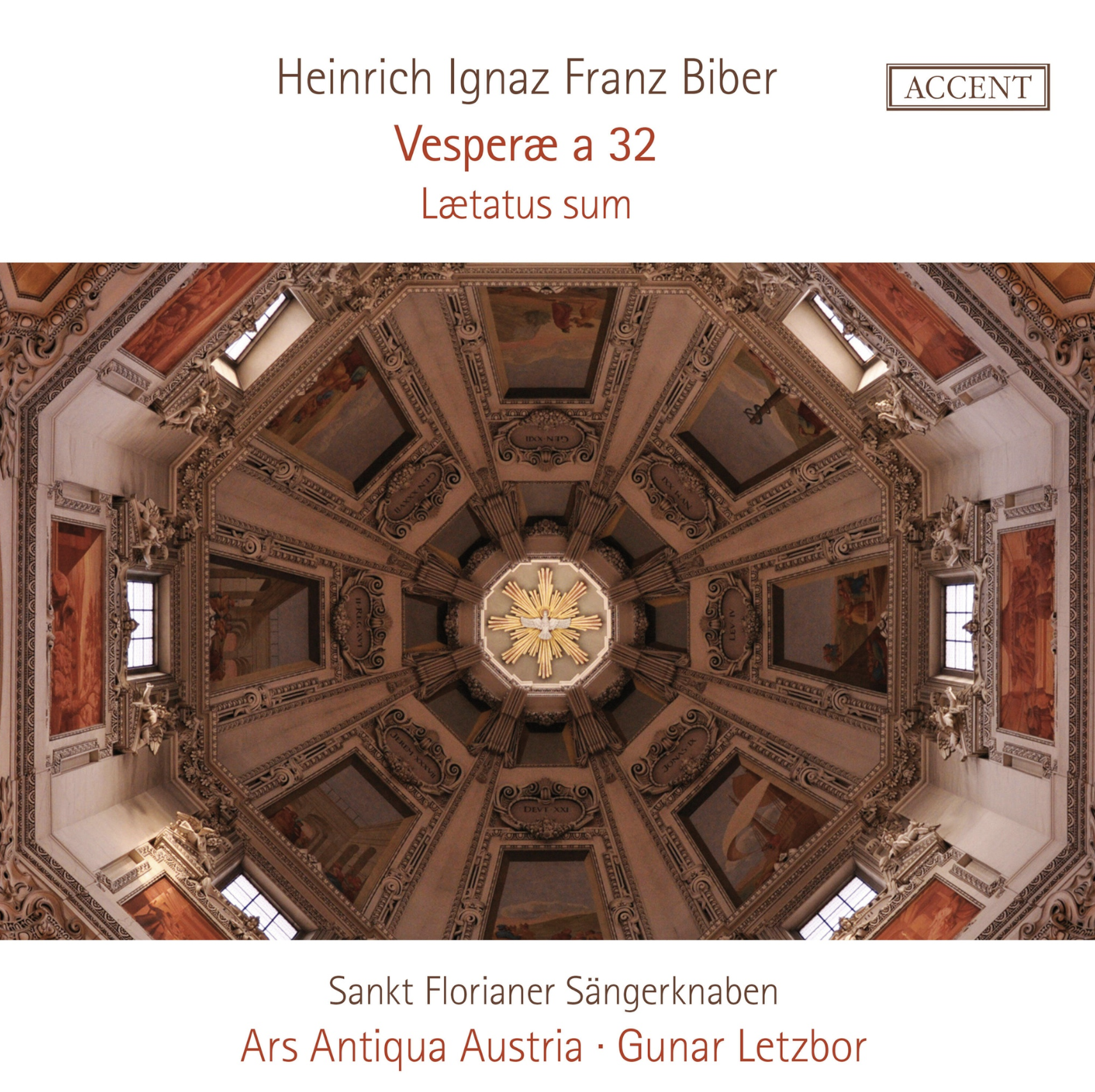
This album's cover is a little short on detail. The music is shared between Heinrich Ignaz Franz von Biber and Benedikt Anton Aufschnaiter (b. 1665). The vespers portion combines Biber's Dixit Dominus and Magnificat, C. 11 and C. 12. Letzbor's own ensemble is joined by the Sankt Florianer Sängerknaben, an all-male choir that uses boys for the higher registers, and augmented by the Salzburger Lautenconsort. The booklet's photos give useful context to the forces involved: one from a concert performance, another from the recording session.
Many of us think of Biber as an instrumental composer, given his famous works for violin. But once he arrived in Salzburg, he had opportunities to write large-scale works for the church. Aufschnaiter was born in Kitzbühel, in the Tyrol, trained in Vienna, and became Kapellmeister at Passau, succeeding Georg Muffat. His surviving output is overwhelmingly sacred, and director Letzbor considers him a Catholic analog to J. S. Bach.
The works, then, were written by different men for different places and functions; their connection is to highlight music important to Austria's past. As the liner notes point out, we have a specific year for the vespers music: 1674. In Salzburg, Biber continued a polychoral tradition established by his predecessor Andreas Hofer; after Biber's own death in 1704, his son took over the post of court Kapellmeister there.
As I've lived with this recording for several days, one thing keeps bubbling up: the sound and quality of boy singers. When combined with adult soloists, the adults here can dominate the boys; then there's the vocal quality itself. That timbre is the distinguishing component of the Leonhardt/Harnoncourt recordings of Bach's vocal works, with their use of boy trebles, as they're called in the English tradition. I often make the intellectual argument for boys in Bach with friends, since it reflects historical practice. One can debate how good the singers were in Bach's day against those available now. But set against arguments about adult women and their vibrato — and the ahistorical judgement that tends to follow — the use of boys sidesteps the whole quarrel in search of an "authentic" sound.
Insofar as boys' choirs and choirs with boys are cultivated in living musical traditions, there's a rationale for hearing these musicians in older repertoire. I raise it because the vocal quality of boys can reach the ear as considerably different from that of adult female sopranos and altos.
Coming clean: there are some issues with intonation and power. But I applaud Letzbor for including the Sankt Florianer Sängerknaben in this production. Giving young musicians the experience of performing high art music, religious or not, is extraordinary for them.
Letzbor also raises an issue that intersects with historical authenticity: what would this music have sounded like in a space like Salzburg Cathedral? He discusses the sweet spot for multi-choral works like these, and how the architecture dictated who would hear anything clearly and cleanly. For most of the congregation, it wouldn't have — a wild thing to sit with when you consider the experience of hearing this music when it was new.
We, of course, get the sweet spot at home. I suspect these pieces were recorded in a far smaller space than the cathedral, yet the engineer, Florian Rabl, manages a fine recording with a real sense of space from a stereo image. It's especially effective with the drums and trumpets, not to mention the interplay of the different choirs.
Vespers music served an evening function in church, typically showcasing dramatic musical innovation meant to glorify God and the Virgin Mary — gratitude for the day, in effect, celebrating its close. Biber's ends with a Gloria Patri, a text familiar to anyone in a Christian tradition, not only Catholics.
Aufschnaiter's Missa Lætamur in ea, for twelve parts, is presented first. It runs to ten movements, including the expected Kyrie, Gloria, Credo, Sanctus, Benedictus, and Agnus Dei. The brass and drums suggest a piece conceived for a special occasion; the liner notes go deeper on its context and dating. To my ears it sounds a touch later in style than the Biber.
While the mass calls for full orchestral and continuo support, the emphasis stays on the voices. The instruments amplify the singing rather than compete with it.
The album also includes a nearly ten-minute Lætatus sum in seven parts by Biber (C. 9), with solo parts for two basses. It's a far smaller work in concept, dispensing with brass and drums. Its special feature is a solo violin part that in all likelihood fell to Biber himself to play — and it's the one work here where Letzbor takes up the violin.
This recording matters for sharing musical traditions specific to particular Austrian locations in the baroque. These are works that, unlike Biber's instrumental music, more than likely never traveled beyond their place of creation.
For any admirer of Biber (and Aufschnaiter), access to these representative pieces sharpens our sense of what a composer's career looked like in Catholic Austria — the musical atmosphere and stylistic signature that predate the composers we know far better today. Hearing how Biber folded his own gifts as a violinist into a religious setting is, for me, the real interest, because it's so unusual.
I've said it before, but it bears repeating: some music is hard to conceptualize through loudspeakers or headphones. I very much wanted to be in a cathedral, like the one in Salzburg, to hear this. Letzbor and his collaborators do what can be done to bring the experience to us as conveniently as possible. This isn't music I'll return to time after time, but the surprises — Aufschnaiter's strong harmonic language and Biber's handling of instruments — were real.