Lemniscate - Bach’s Die Kunst der Fuga • New Collegium
Introduction
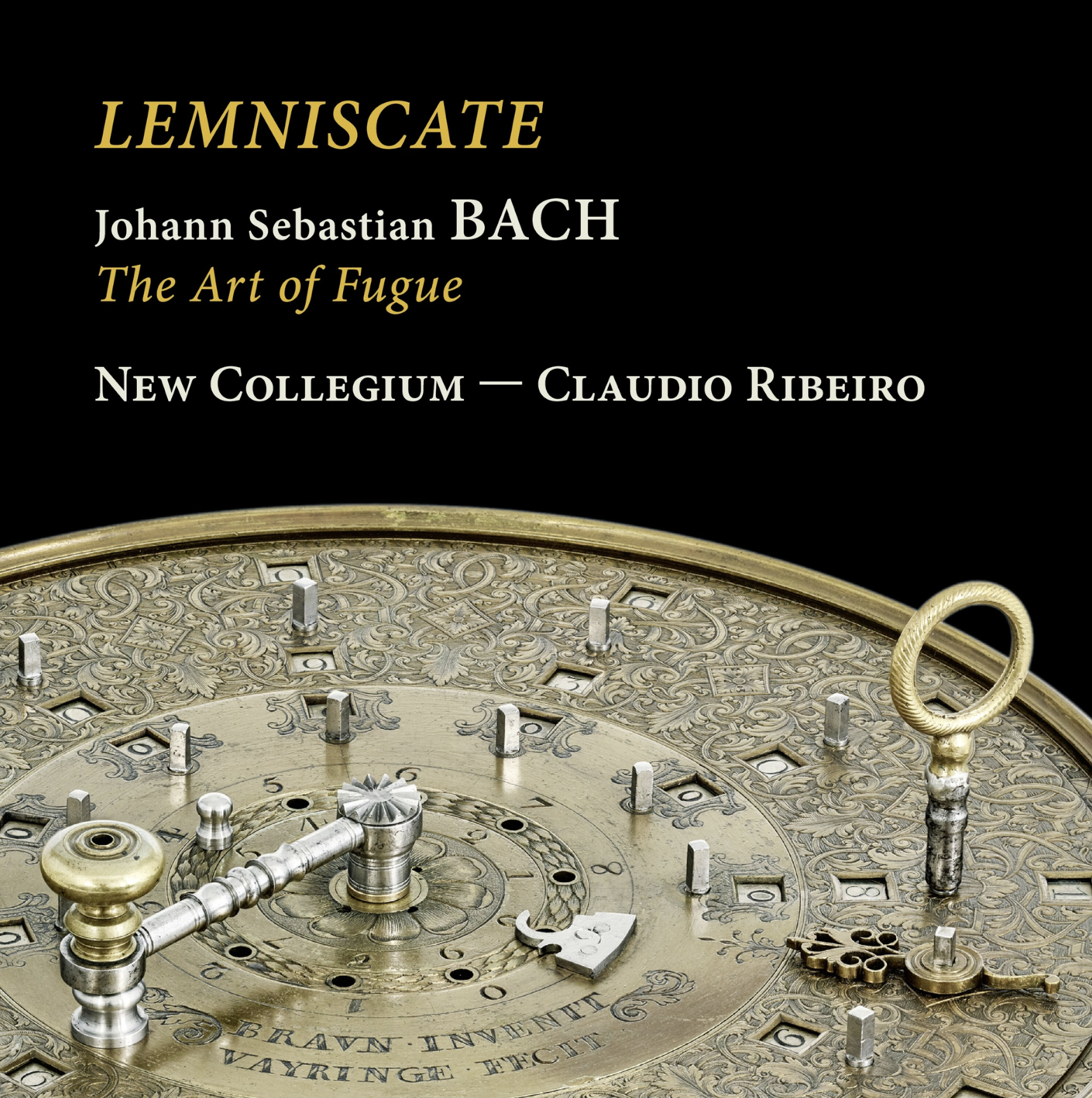
The calculating machine on this album cover is a handsome image, but it doesn't tell us what lemniscate means—probably not a word in most listeners' vocabularies. It refers to the infinity symbol: a sideways 8. The Latin root has to do with decorating with ribbons.
It's an interesting word, then, for Bach's Die Kunst der Fuga. Marketing-wise it might make the disc hard to find under BWV 1080, but the title is distinctive enough to set the album apart. You'll notice I write Fuga, not Fuge. A facsimile of the earliest manuscript in the liner notes gives the original title as Fuga — the Latin (and Italian) noun dropped into an otherwise German title, where you'd expect the German Fuge. Some numerological readings suggest a reason for the choice: Bach liked to play with numbers, and Fuga, rather than Fuge, may have been the spelling that made the math work. His family and friends may never have realized what game he was playing; I can't say myself how widely his interest in numerology was understood.
We don't hear it directly, of course. But Bach worked in a tradition that held musical knowledge to be built into the structure of things — the old idea of a music of the spheres — so it's no surprise he'd embed a logical order even where the ear can't catch it.
Today we might call these easter eggs, the kind hidden in software. But for Bach they were surely more than a joke: he believed they gave the music extra value.
The Music
Every recording of this work needs an angle. The piece survives in open score with no instrumental designation, so an ensemble has to decide who plays what; and because the work comes down to us in more than one version, they also have to settle on an order. This album presents the order of the earliest version. And, against the preference of Bach's son Carl Philipp Emanuel, New Collegium performs it on a variety of instruments — winds, brass, strings, and harpsichord.
The Recording
The recording was made at Westvest90, in Schiedam — a cultural center in what appears to be a former church. The acoustic has a church-like signature, with a fair amount of reverb. Not every instrument sits at the same distance from the listener, but overall the sound supports the music well.
I should add that New Collegium is a HIPP ensemble, and its instruments match those Bach used in the cantatas: viola da gamba, recorder, traverso, oboe, oboe da caccia, cornetto, trombone, bassoon, and of course harpsichord — but no organ. I've had issues with ensembles that throw the kitchen sink at this work. Look at Bach's own orchestration, especially across the cantatas: he assigns particular instruments, and particular combinations of them, to particular themes and moods. It wasn't color for its own sake.
Beyond that, some performances pick a single instrument that can't cover a whole part because of range, and the workarounds bear no relation to Bach's own practice. I've found them artificial and ill-conceived.
None of that troubles me here. The choices come off naturally, and the playing is stylistically consistent across winds and strings. Bach might still have questioned the approach, but I'd like to think its novelty helps reveal his counterpoint for the listener.
The Interpretation
The piece is treated with respect and reverence throughout. Each movement is taken on its own terms, underlined by the changes of instrumentation from one to the next. The playing is affective, well shaped dynamically, and every performer is technically sure.
What will catch listeners who know the piece well is the presence of apparent "mistakes." They may not be mistakes at all: a note that now reads as a sharp, or as a natural, first strikes the ear as wrong, but the 1751 printed edition applied corrections the earlier readings don't carry. To me they don't detract — they add to the charm.
The most ambitious of the contrapuncti is the final track, the famous fugue on three subjects. It brings a different instrumental grouping to each section.
I hope one day to write something more formal about why this last movement moves me so. The opening on trombone wasn't what I expected, and the combination with bassoon and cornetto is deeply affective — I gripped my chest. New Collegium took a profound piece of music and elevated it. Maybe I'm biased as a former brass player, but music that breathes touches us in special ways.
Switching instrumental choirs was the right move. The entrance of the B-A-C-H theme on bassoon struck me as tongue-in-cheek, given Bach's own long-ago row with a bassoonist. As a good performance of this movement often does, it moved me to tears.
Conclusions
This recording is special to me because it preserves what we can reconstruct of Bach's original concept for his ultimate work — and does so with gifted musicians who clearly approached the project with care.
I've written elsewhere that I take this work as Bach's own thesis on counterpoint. His family found it after his death and likely didn't fully understand or value it; they may have seen it as their father's retreat into old-fashioned forms. But counterpoint was central to how Bach conceived music. I believe he held it to be the foundation of the art, and a reflection of the complexity and grandeur of his creator.
The album is at once creative and historically informed, with an eye to satisfying contemporary listeners.
Even if you already have a favorite recording or two of this work, this one is worth multiple spins.