Herstory • Luke Welch
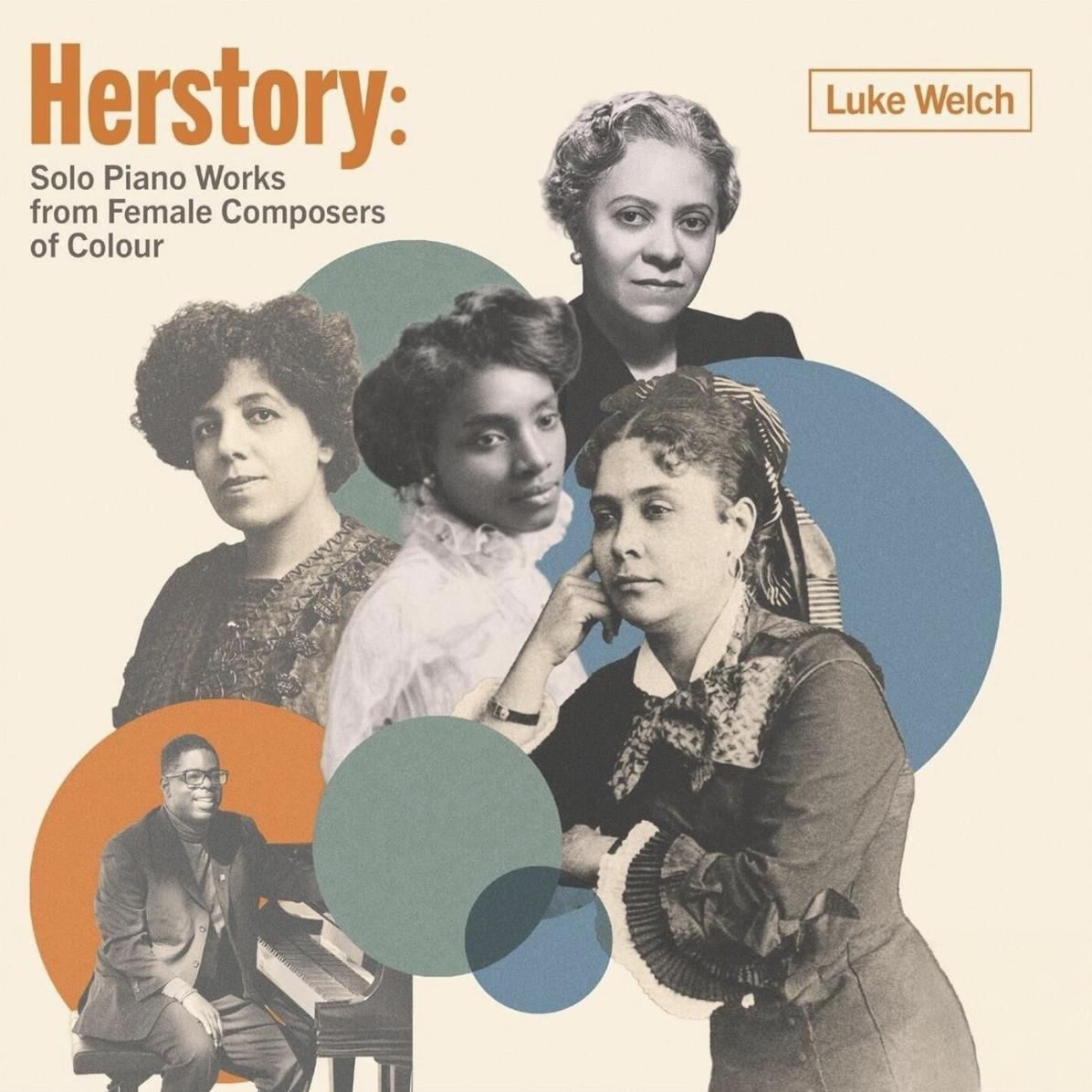
This short album of solo piano music features compositions from, as the cover indicates, “female composers of colour.” Represented are Florence Price, Chiquinha Gonzaga, Montague Ring, L. Viola Kinney, and Estelle Ricketts. This recording has a very lively and transparent sound; I felt I wasn’t right up and on top of the instrument, but the piano’s sound fills the room it’s in. It’s an aspirational sonic presentation that would benefit many solo piano recordings.
Price entered the New England Conservatory in 1903. She would later become, in 1940, the first African-American woman inducted into ASCAP.
The short Etude that opens the album is an interesting piece. It’s built upon a repetitive cell that, like Bach’s C major prelude BWV 846, cascades through different harmonies. Most of the piece feels contemporary, as if it were written today, until things set up for the final cadence, and the harmonies speak to a time past. The piece ends too soon. The second piece by Price is entitled Memory Mist and feels well-positioned to tell a story, perhaps one told through a silent film. The piece is more grounded in tonal harmony, but there’s a nod to Debussy somewhere in the harmonic language.
Born in 1847, Gonzaga was Brazil’s first woman conductor. She was an activist and completed her last work, an opera, at the age of 87.
Her Grata Esperança has a populist charm; the simple harmonies play second to the figurations required in the melody. The piece may qualify as a waltz, and two images come to my mind: first, a room full of people dressed up dancing, and second, the style of early twentieth-century music you’d hear playing when you ride a merry-go-round. The bones of the piece might have been scored for a band, but the details clearly present a piece for the piano. The Sultana that follows acts, concerted or not, as a coda to the longer piece before it. The B-section comes off as novel, given the formal structure that opens the piece. The mood, for me, evokes wonder and happy times.
Amanda Christina Elizabeth Aldridge (b. 1866) wrote under the male pseudonym of Montague Ring, born in England to an African-American father and a Swedish mother; she lived there her whole life, becoming an opera singer and teacher.
Welch performs her Four Moorish Pictures suite from 1927. Each of the pieces is short. They explore “eastern” style themes. While Prayer Before Battle is the better known of the pieces, I liked Twilight Dance best. The left hand is stuck in a short repetitive pattern acting as a drone; the melodic material that lives above it offers a strong mood, or something more — I feel its shape helps us come into the scene and then quietly depart. The final movement, Dance of Triumph, again depends upon the right hand to do most of the work. It does well to evoke the culture and exoticism of a far-away place.
Lady Viola Kinney (b. 1891) was an African-American composer from Missouri. Mother’s Sacrifice was published in 1909.
Mother’s Sacrifice belongs to the same period as these other pieces stylistically, but the voice behind this piece is markedly different. One could imagine the harmonic background to work as a chorale; instead two things happen. First, she uses repetitive cells to turn the piece into something for the piano; second, she employs some surprising harmonic shifts. The repetition, for me, isn’t its strongest component, but it helps the listener focus on those interesting harmonies. Formally, the opening and closing are bookends, indulging in a bit of schmaltzy territory, something not foreign to the period. The piece stands out because of its middle section, one that likely was seen as highly novel.
Ricketts (b. 1867) wrote Rippling Spring Waltz, the first known piano solo written by a Black woman. It’s inventive in how Ricketts throws new rhythmic and thematic material over a repeated harmonic foundation. There’s a charm to be had in the pianistic touches, which Welch does well to exploit cleanly.
Conclusions
This album took me out of my comfort zone of the seventeenth and eighteenth centuries. It’s easy to forget that composers in the baroque, like musicians today, were pragmatic. They didn’t necessarily have free rein to compose anything they liked; they were beholden to customs, employer expectations, and the function music provided in daily life.
These pieces—coming from diverse voices across the turn of the century—reflect the society of these women and the function music had in their lives. While some of them wrote for orchestral forces, there’s something both limiting and freeing in just writing for the keyboard. What came out strongest for me is how firmly these pieces felt as piano music. The influence of dance, of popular idioms, and the ability of music to tell stories are all on display here. It might be easy to hear these pieces as trite artifacts of a bygone era, but they hold up under scrutiny as more than that.
They were written by women in a time that was still dominated by male musicians. For me there’s a strong imprint of emulation, but the solutions are not simple, as the character of these pieces might first imply. It shows us that these women not only had developed talent to play, but gained the ingenuity to each convey unique solutions to the forms they used. Kinney’s harmonic progressions, or Ring’s evocation of exotic music, are ample evidence, as is Ricketts’ evolution of musical ideas within the frame of a short waltz.
I’m appreciative of Luke Welch’s exploration of this repertoire. It helps bring to light, through sound, voices that we may find easy to ignore. And we shouldn’t. One reason may be that these were women, with voices in a male-dominated profession; the other is that these were composers of color. This album is too short at 37 minutes, but you’ll find that if we park the biases of society at the door, there are riches to be uncovered, even in miniature.