Orlande de Lassus (c. 1532–1594) was arguably the most versatile composer of the late Renaissance, and the one who most fully embodies the Franco-Flemish tradition at its culmination. Born in Mons and trained in the Netherlandish choral world, he held posts in Italy before joining the Bavarian court of Duke Albrecht V in Munich in 1556. He became Kapellmeister there in 1563 and held the post until his death in 1594. His output of roughly 2,000 works spans every major genre and four languages. The sacred repertoire includes motets, masses (many built on secular models), about a hundred Magnificats, Passions, and the austere Psalmi Davidis poenitentiales. Alongside it sit Italian madrigals, German Lieder, and French chansons, some of them bawdy. He wrote for the Catholic liturgy and for private devotion, for dynastic ceremony and courtly entertainment, and for a European print market that he exploited as shrewdly as any musician of his century. What makes him endure is the range of expressive registers he commanded: the penitential gravity of the Lagrime di San Pietro and the chromatic strangeness of the Prophetiae Sibyllarum stand alongside drinking songs and comic patter, and his text-setting turns each into rhetoric made audible.
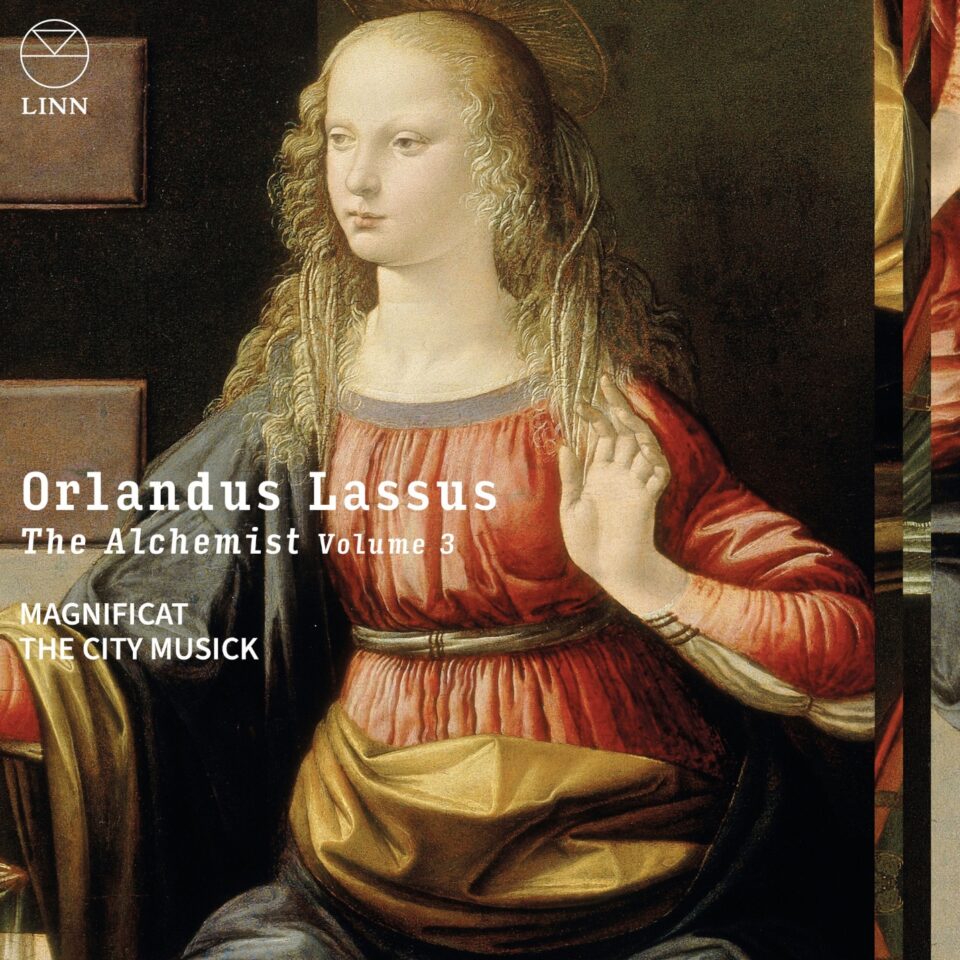
Among my favorite recordings of Renaissance music was his mass for double choir, performed by the Tallis Scholars on Gimell (Missa Osculetur me, 1989). The music sounded so ripe, and it had a true surround-sound effect on me back in the 1990s. This recording, third in a series that I have not actively followed, features the vocal ensemble Magnificat, directed by Philip Cave, with their colleagues from The City Musick, a Renaissance band. The series aims to present the composer’s Magnificats, and this album is a two-disc affair offering those that derive from polyphonic chansons. The chansons here are popular songs, some with suggestive lyrics, an odd starting point for music meant for the church. To our benefit, the program pairs each chanson with the Magnificat built on it, so we hear both the inspiration and the sacred work Lassus made from it.
The liner notes explain why Lassus built these works on popular material. One reason was the stimulus of making something new out of something old; the other was the familiarity of the tunes, which could be turned into something both recognizable and practical for worship. He would have written these for the Bavarian court in Munich, where he had built a reputation and a long-established career.
Magnificat, the ensemble, is made up of three sopranos, one male alto, two tenors, a baritone, and two basses. They sing with appropriately straight voices, without vibrato. There’s a real purity to their voices, and in such small numbers the works benefit from excellent clarity and transparency. William Lyons’s City Musick is composed of Renaissance winds, lutes, and organ. The recording was made in 2025 at St. John the Evangelist Church in Oxford. The two earlier volumes appear on Linn CKD 660 and CKD 760.
Track 9 of the second CD is the famous Susanne un jour in Lassus’s own setting. The text is by Guillaume Guéroult (b. 1507), drawn from the story of Susanna in the Book of Daniel; the tune comes from Didier Lupi Second. The Magnificat setting follows on track 10 (LV 891). The chanson is led by a solo tenor accompanied by lute, and the melodic material is easy enough to hear as the polyphonic work begins. For my taste the recording is well balanced, the singers each distinct, and the effect is one of purity of sound. I can’t speak to the use of female singers, but in this context the balance among voice types is well done. The sound is up close and may betray the experience of hearing it in a large church, but I’d rather have the texture and full timbre of the voices available to me in high resolution.
CD 1, track 11 features Helas, j’ay sans mercy, performed on instruments, as set by Lassus (LV 787). The sound will transport you to your local Renaissance faire. Humor aside, the instrumental playing is very finely done, with a distinct timbre from each instrument and good intonation throughout. As the liner notes put it:
Lassus’s version has a catchy canzona-like refrain that alternates with contrasted verses, but with few direct repetitions.
The lyrics of the piece include references to spring and summer, such as:
When the season turns green, / And brings forth every flower, / It is a pleasure and a joy, / To choose the colours, / And to pluck the flower, / That has most fully bloomed.
In this case there is no sung chanson, and the Magnificat follows directly on track 12. The female voices are far smoother and kinder than the instruments’ presentation. Organ, played by Edward Higginbottom, provides foundational support, and the instruments return to add color and relief from the sung portions.
I’m not used to hearing instruments with Lassus’s music. Both the small ensemble of singers and the Renaissance instruments offer honest context for the music as it may well have been heard. The exploration of popular song, and Lassus’s application of that material to music for court services, shows both his creativity and his awareness of the need to connect with his audience. For me this album offers a new insight into Lassus as composer and high Renaissance musician. This two-CD set may be a bit much for contemporary audiences in one sitting, but the music and the performances are both of the highest quality.