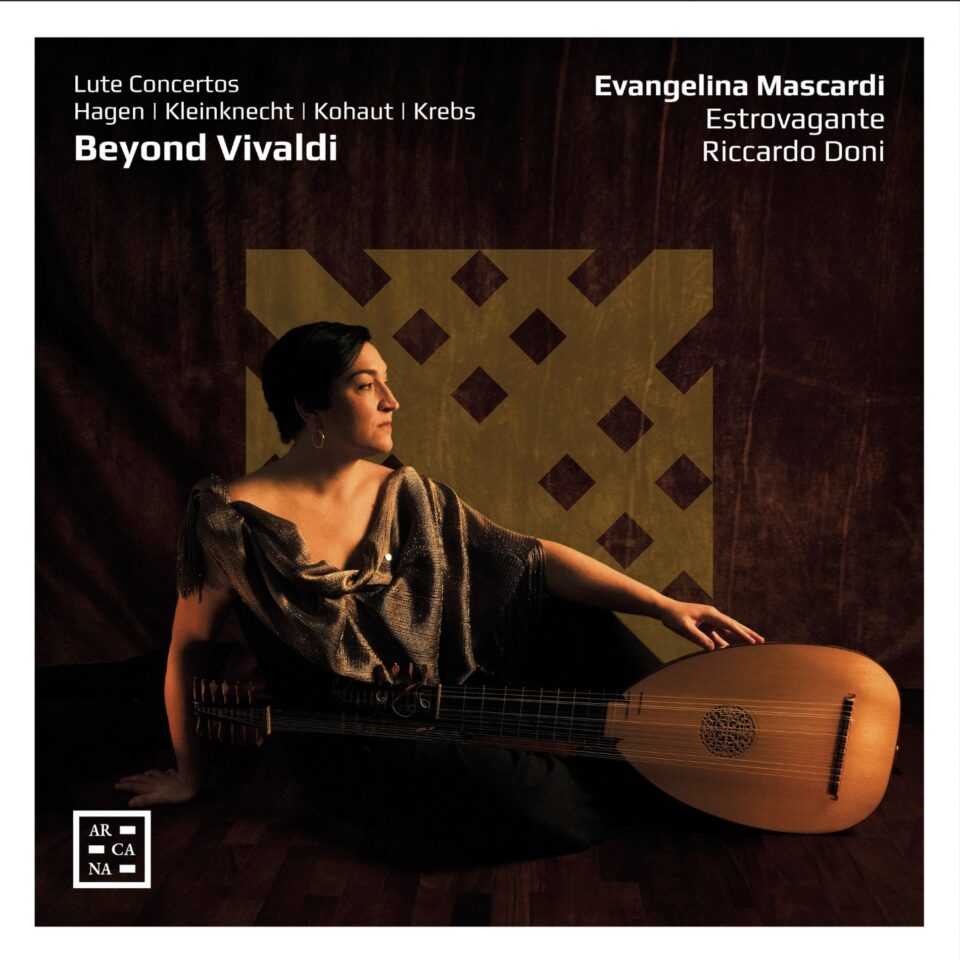
Evangelina Mascardi has impressed me over the past several years, not least with her Bach on the lute. Here, with Riccardo Doni’s Estrovagante ensemble, she turns to lute concertos by Krebs, Hagen, Kleinknecht, Kohaut, and the familiar Vivaldi (for context, of course). Vivaldi didn’t write an extraordinary amount for lute: one solo concerto, a double concerto with viola d’amore, and a pair of trios, though he left us mandolin concertos, too. The album shows that other composers were drawn to the plucked instrument as well. It had perhaps not the greatest projection power, but plenty to offer in solo virtuosity under the right fingers.
The booklet offers a comprehensive essay on the provenance of these works, citing both Vienna and Prague as cities that helped cultivate the lute concerto. Among the figures it credits for preserving the late repertoire is Wilhelmine, Margravine of Bayreuth, who of course was Frederick the Great’s sister. The Hagen and Kohaut concertos are both world-premiere recordings.
The ensemble comprises six violins and one viola with continuo, which includes theorbo. The size seems perfect as a back-up band for the 14-course lute used for the solos. The acoustics come across nicely; the album was recorded at the Archivio Storico Diocesano in Vigevano in November 2024.
The Concertos
The F-major concerto by Johann Ludwig Krebs is in three movements. It’s been recorded at least once; via Qobuz I found a 2013 recording by Michael Schönheit. The writing aligns with the composer’s years (1713–1780), a bit more rococo than baroque. Most definitely not Vivaldian, but not terribly foreign in style. His development of theme and harmonic changes is more interesting than the typical Vivaldi model, and the lute is given a number of solo episodes to shine by itself. A fine piece of music.
Hagen‘s (1720–1787) D-minor concerto feels a bit more baroque in character, but he takes the solo work into far more melodic territory than something formulaic, again showing his place in musical history. For me, his writing qualifies his experience with the instrument. I kept thinking back to the album of Berlin viola concertos that Ensemble Diderot recently put out, in terms of those composers’ style; Hagen’s writing isn’t far off. The middle movement is far more galant, again emphasizing melody, first presenting it in the strings before passing it off to the lutenist. The conclusion is shorter, offering maybe not fire, but something smoldering nevertheless. There’s a little humor in the string introduction too, just enough to delight the audience.
The Vivaldi concerto (RV 93) has been well recorded, and is famous to me as the Crisco cookie commercial soundtrack. The playing from the ensemble isn’t as crisp and lean as the Il Giardino Armonico version on Teldec, but it’s finely played, and Mascardi shines in her role.
Karl Ignaz Augustin Kohaut‘s concerto in E is the longest on the recording. His years, 1726–1784, also showcase the late appreciation for the lute concerto. His writing is a bit different from the other composers represented; he’s interested in integrating some of the strings into the fabric when the lute is playing, and the difference is refreshing. The tempo works well in the first movement for the ritornellos, but the solo writing could have benefitted from a bit more speed; it’s not until the lute writing becomes more complex that the adopted tempo makes more sense. I don’t fault the musicians here as much as the composer, for how he constructed the solo parts as slow and searching before the more virtuosic passages followed.
The composer shows his style again in the slow movement, which opens with a minute-long solo before the continuo joins the lute. His opening ritornello in the third movement is a rather searching theme; it’s well written but maybe not finely written? He’s trying some interesting things in the way of harmonic progression, too. His musical voice, in a way, keeps our attention spans open and waiting.
Conclusions
This album does well to showcase the lute as the center of attention as musical styles were changing in advance of what we today call the classical era. In many ways these concertos show the last hurrah! for the lute, and how easily the instrument could be adapted to the new, melodic style. As the liner notes share, some composers found the limits of the instrument to modulate part of its ultimate demise by Mozart’s time. As expected, Evangelina Mascardi is an excellent musical ambassador in showcasing for us these works.
There were a few times when intonation between the first violins came into question for me, but overall Doni’s ensemble responds well to the demands of supporting the lute across these concertos. The music here is high quality and includes compositional voices that should have our attention. Framing these works against the familiar Vivaldi concerto was a smart move; I also liked its position in the center of the album.
This album should appeal to fans of the rococo style and those who admire the lute.