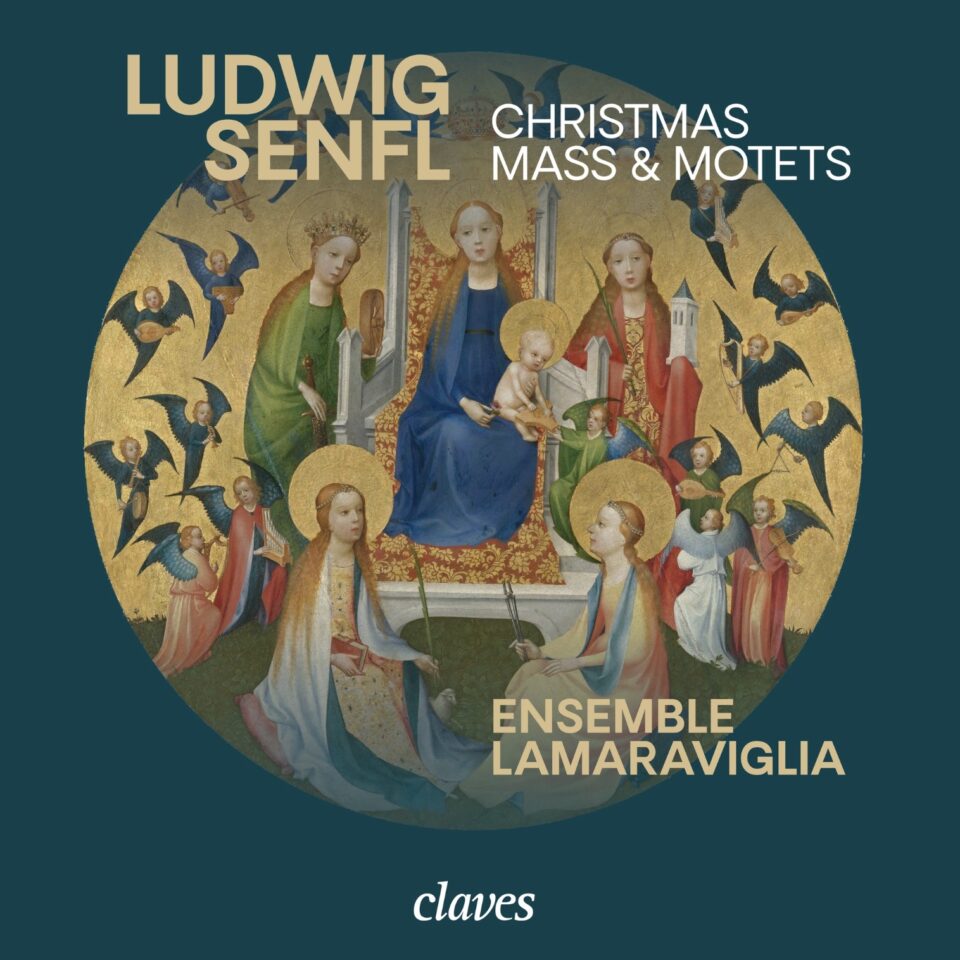
It’s likely you’re unfamiliar with the name Ludwig Senfl, a Swiss Renaissance composer born between 1489 and 1491. After service in the court chapel of Emperor Maximilian I, he was appointed court composer to Duke Wilhelm IV in Munich. He wrote works for both Catholics and Protestants, despite the duke’s allegiance to Catholicism. This album assembles a Christmas Mass from Senfl’s Proper for the Third Mass of Christmas Day (In Nativitate Domini ad tertiam Missam) and his Ordinary, the Missa dominicalis (II). Around it are keyboard works from the tablature of Leonhard Kleber (c. 1495–1556), a preamble by the album’s organist, Joseph Laming (b. 1996), and three motets: Nesciens mater virgo virum, O magnae admirationis gratia!, and Virga Jesse floruit. The first two motets are recorded here for the first time; O magnae survives in only three of its four voices, and the ensemble reconstructed the missing part. Lamaraviglia has arranged the program to give the mass a liturgical context, heard alongside the music that would have surrounded it.
To ensure that as many parts of the Ordinarium and the Proprium as possible could be rendered polyphonically, works by various composers were drawn upon where necessary. For the Third Mass on Christmas Day, Senfl could thus have combined his Proprium cycle – consisting of the four Mass sections Introitus, Alleluia, Sequentia, and Communio – with either one of his own settings of the Ordinary or that of another composer, such as Heinrich Isaac. From the countless settings of the Ordinary available for completing a Christmas Mass at the court of Wilhelm IV, Lamaraviglia selected Senfl’s four-part Missa dominicalis (II). The chorales used by Senfl clearly indicate that he composed the Mass for a feast day.
How to listen to this repertoire
While this is not a fast rule, it seems the older the music, the more difficult it is to perform convincingly. Some might argue that the older it is, the more difficult it is to enjoy. That’s not a slight to the musicians who assembled this recording. For many of us there is a large divide here, one that’s easy to measure in years but is really born of musical traditions, performance practices, and the purpose the music served in the first place.
Today it’s not uncommon to hear the music of Johann Sebastian Bach around us. It’s far less common—I’d say non-existent—to hear Senfl. So there’s a familiarity problem: we recognize music first by style, then by composer. All music, I remember hearing in a course once, should “live on its own” without our having to make a case for why it should be heard or performed. If we’re doing that, then we’ve missed the mark. The music or the performance didn’t pass the test.
For those not accustomed to Renaissance music, this repertoire can come across as tuneful in sections, but it lacks the functional harmony that solidifies by 1680–1700. Chronologically, these vocal works sit between Gregorian chant and the polyphonic writing of, say, Bach in his B-minor Mass—though Senfl’s counterpoint is a mature idiom in its own right, not a way station. The music was conceived more horizontally than vertically, with attention to which intervals were allowed and which weren’t. The music should move us, yes, but that’s a difficult thing to do when the harmonic and rhythmic systems we’re used to can’t yet be applied.
Instead, the Renaissance believer would have heard familiar tunes decorated with more than one part or voice. Without recognizing these melodies, we’re left with only what sounds familiar to us. Here the album does us a favor. In the alternatim movements, verses of chant alternate with their polyphonic settings, so you hear the tune and then hear what Senfl builds upon it. It’s the closest thing to a built-in listening guide this repertoire offers.
What you’ll hear
The ensemble’s singers are well-trained in direct singing that comes across clear in this recording. Their singing lacks the emotional punch and contrasting dynamics of the baroque, but clarity is a virtue here. The audience of time would have needed to hear the text. These musicians make that a priority.
The instruments used—cornets and early trombones—add color and weight to the music. The instruments’ timbres will probably be familiar to most, and these instruments blend well when accompanying the singers.
Finally, the keyboard playing is well-articulated. Neciens mater virgo virum is offered without the voices, and just instruments, detailing another way these pieces may have been performed. The playing throughout is consistent and sensitive.
All this said, this is difficult music for a wide audience. Significant study goes into bringing it to us, from the pronunciation of the Latin, to the use of instruments in doubling, to imagining how the music functioned as part of a religious service. To have music like this made for you? It showed your importance and station in life. The chant underneath belonged to everyone; the polyphonic elaboration—and especially the motets, written for the duke’s private devotions—was meant for the few.
The keyboard works may be more accessible to a general audience. The playing is quite good, and the organ has a nice sound. These pieces are again constructed through counterpoint; rather than thinking about melody and rhythm, we should listen for how a composer takes a small germ of an idea and elaborates upon it across the abilities of two hands. The writing is florid, in the improvisatory manner of the period. The pieces serve here to bridge one work to the next. They aren’t profound in their construction or effect on us, I gather, but they showcase a practice aligned with the approach heard in the vocal works.
Conclusions
Prior to this album I was unfamiliar with Senfl. The sound on offer gives us the illusion of a court chapel, though the recording was made at Waldenburg Studio in Switzerland. The effect is a clear and direct recording with a small amount of reverb. The organ, played by Joseph Laming, is among the loudest sounds on the album. The inclusion of cornets and sackbuts is historically supported; Maximilian’s chapel was a pioneer in having winds play alongside the singers.
This is an important document of a Swiss-born composer whose career unfolded in Habsburg and Bavarian courts, offering us an opportunity to contemplate religious music that never had a wide audience. It also offers a glimpse into the musical culture that played a role in the lives of noble society.
If you’re interested in exploring other Christmas music and old traditions, this repertoire may fit the bill as something old in a new bottle. My advice for anyone looking to enjoy these pieces is to stick with one over repeated listens, letting the melodic material become familiar. The Ensemble Lamaraviglia are sympathetic partners in this work, making something foreign to many accessible in this holiday package.
Readers interested in Senfl’s influence and legacy may find content of interest at this website devoted to the composer and his works.